Why Sourdough Timing Is the Hard Part
Ask any experienced baker: the recipe isn't what makes sourdough difficult. The timing is. A sourdough starter is a living culture of wild yeast and lactic acid bacteria, and its fermentation speed changes with every variable in your kitchen. The same 1:5:5 feeding that peaks in 8 hours at 22°C peaks in 4 hours at 28°C — and takes 14 hours at 18°C. Whole wheat ferments 50% faster than white flour. Rye, twice as fast.
Recipes give you fixed times: "feed your starter 6 hours before mixing." That works only if your kitchen happens to match the recipe author's kitchen on the day they wrote it. The rest of the time, you're guessing — and a starter used past its peak gives you a flatter loaf with sharper acidity, while an under-ripe one won't leaven properly at all.
S.D TIMER replaces the guessing with fermentation math. It models the temperature response (a Q10 coefficient of roughly 2 — every 10°C doubles fermentation speed), the non-linear effect of feeding ratios, and per-flour multipliers calibrated against real doughs. You set the target; the schedule adapts to your conditions.
What the Scheduler Does
Reverse calculation
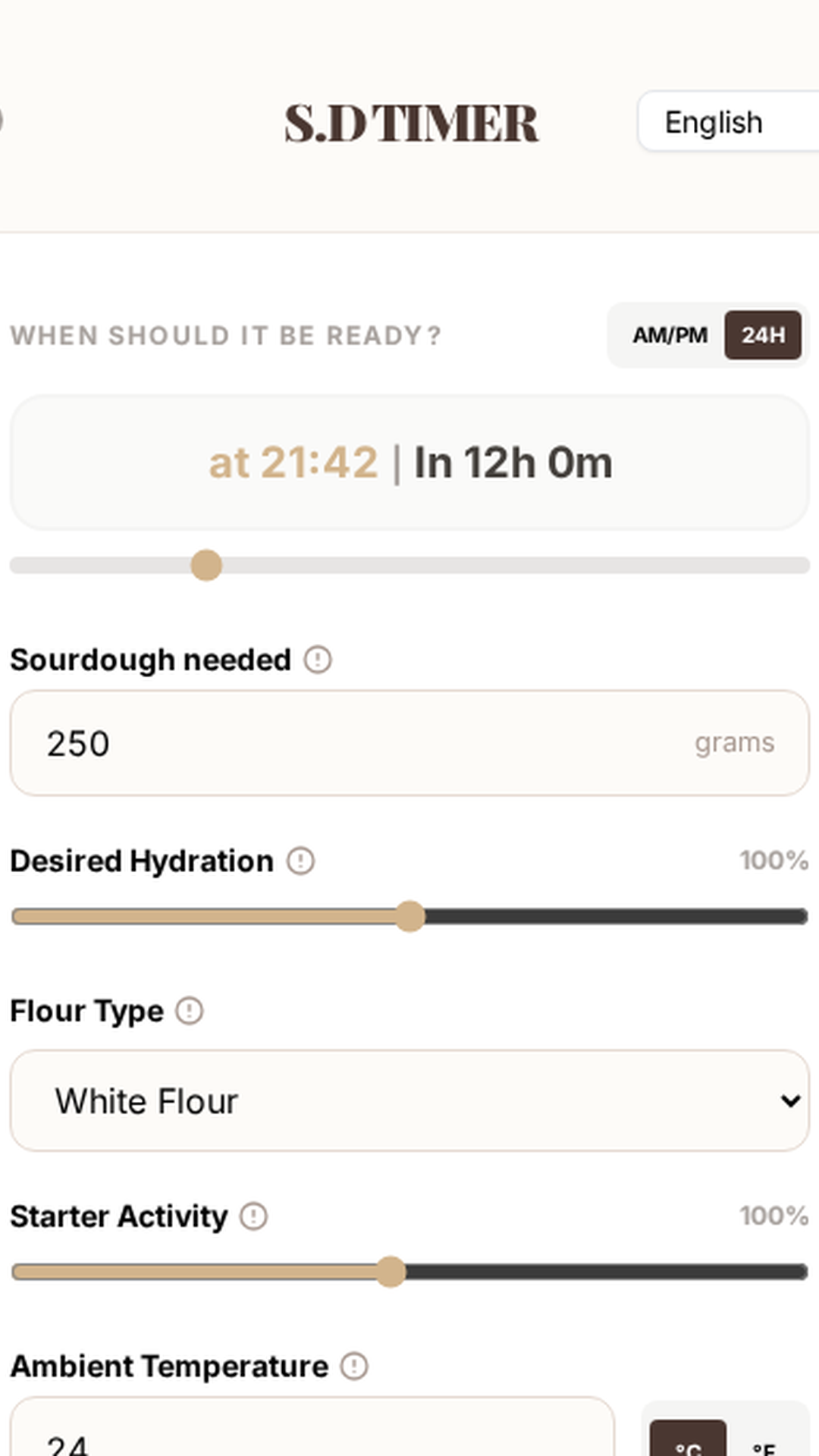
Set your target bake time. The app builds the entire schedule backward from it — feed, mix, fold, shape, proof, bake.
Temperature compensation
Enter your room temperature. The same recipe produces a different — correct — schedule in summer and winter.
Flour-aware
White, whole wheat, spelt, and rye each get calibrated multipliers. Blends use a mass-weighted average.
Fermentation curve
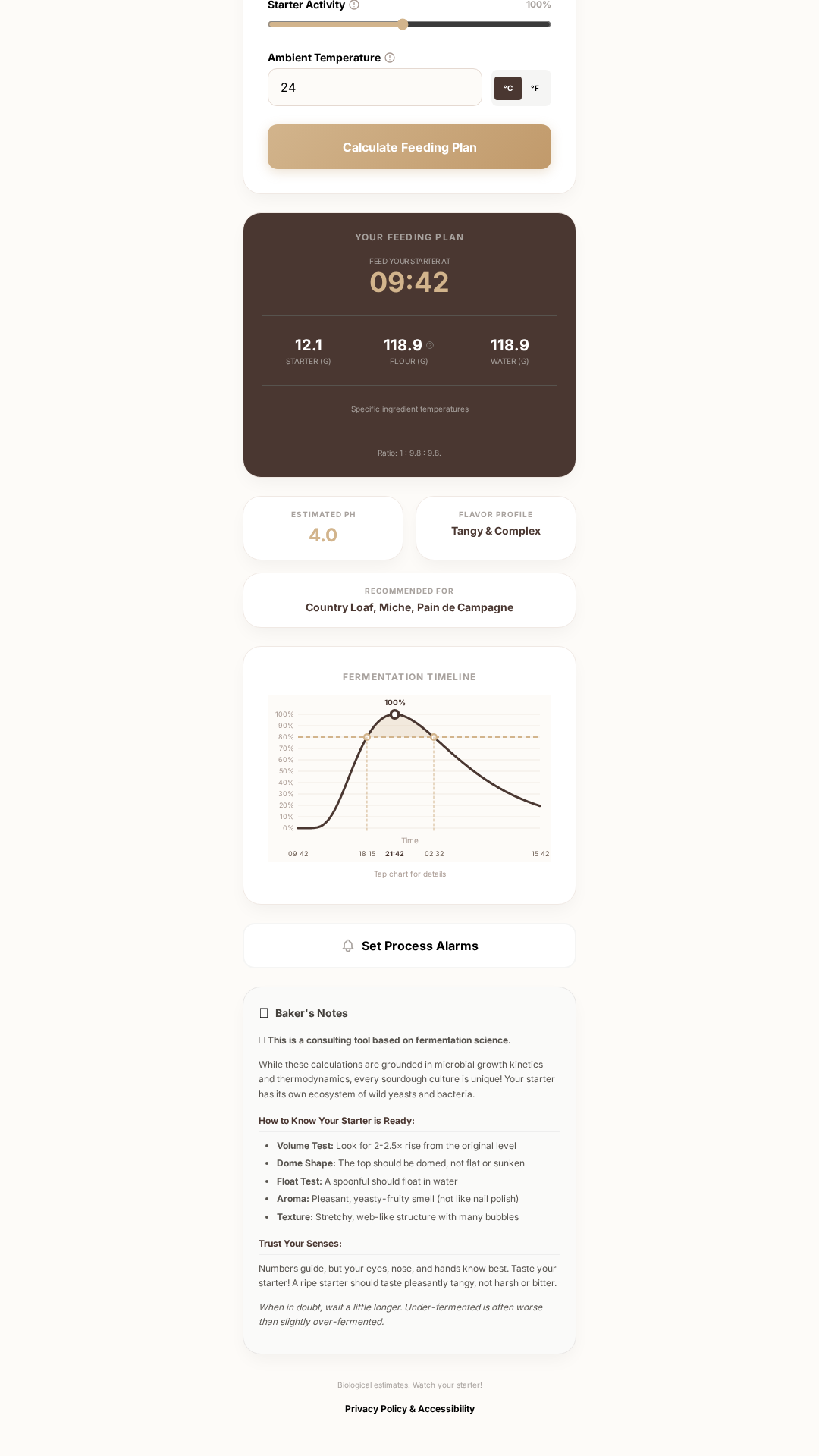
A visual curve shows your starter's usable window — from 80% rising through peak to 80% falling.
Smart notifications
The app reminds you when to feed and warns you when your levain is approaching peak.
8 languages, offline
English, Hebrew, French, Spanish, Arabic, Hindi, German, Dutch. Works offline once installed.
How It Works — Three Inputs, One Complete Schedule
Set your target
"I want fresh bread Sunday at 7am." That's the only decision you make. Everything else is computed.
Describe your conditions
Room temperature, flour type, hydration, and your starter's activity level (calibrated from its observed doubling time). Thirty seconds of input.
Follow the timeline
The app returns exact clock times: refresh the starter Saturday 14:00, mix 20:30, shape 23:45, cold retard overnight, bake 6:15. Notifications keep you on schedule.
The Science Behind the Schedule
A sourdough starter is a stable, symbiotic culture of wild Saccharomyces cerevisiae and lactic acid bacteria, primarily Lactobacillus species. Fermentation rate is governed by three coupled variables, and S.D TIMER models all three:
Temperature — Arrhenius kinetics
Enzymatic and microbial reaction rates roughly double for every 8–10°C increase within the viable range (4–40°C). This is the dominant lever: a 2°C difference between your kitchen in June and December shifts a schedule by an hour or more.
Inoculation ratio — non-linear population dynamics
The proportion of mature starter to fresh flour controls the lag phase. A 1:1:1 feed peaks in 2–4 hours at 22°C; a 1:10:10 feed takes 10–14 hours — but doubling the dilution does not double the time, because exponential growth catches up once it starts. The app's curves encode this non-linearity.
Flour composition — enzyme and mineral load
Whole-grain flours carry more amylase activity, more minerals, and a larger native microbial population. The calibrated multipliers: white 1.0×, spelt 1.35×, whole wheat 1.5×, rye 2.0×.
| Feed ratio | Peak @ 18°C | Peak @ 22°C | Peak @ 26°C | Peak @ 30°C |
|---|---|---|---|---|
| 1:1:1 | 4–6 h | 2–4 h | 1.5–3 h | 1–2 h |
| 1:2:2 | 5–8 h | 3–5 h | 2.5–3.5 h | 1.5–2.5 h |
| 1:5:5 | 10–14 h | 6–8 h | 4–5 h | 3–4 h |
| 1:10:10 | 14+ h | 10–14 h | 7–10 h | 5–7 h |
These reference values are for a white-flour starter; the app adjusts them live for your flour, hydration, and starter activity. For the full background, read our guides on recognizing starter peak, inoculation ratios, and desired dough temperature.
Built by a Professional Baker, Not a Software Company
Free Sourdough Tools
Also available in:
Sourdough Secrets — The Science Library
Long-form, referenced articles on the chemistry, physics, and microbiology behind every stage of sourdough baking:
Stop Guessing. Start Scheduling.
Free on iPhone, Android, and the web. No account required.
Frequently Asked Questions
What is a sourdough starter scheduler?
A tool that calculates when to feed your starter so it peaks exactly when you need it for mixing dough. Unlike a fixed recipe schedule, it accounts for temperature, feeding ratio, hydration, and flour type — the variables that change fermentation speed every single day.
How is S.D TIMER different from other sourdough apps?
It works backward. You enter your target bake time; the app calculates the entire chain in reverse — starter refresh, mix, bulk fermentation, shape, proof, bake — using calibrated fermentation curves instead of fixed recipe durations.
Is it free?
Yes. The web app at sdtimer.com/app is completely free with no account. The iPhone and Android apps are free with ads. A Pro version is available ad-free.
Does it work for whole wheat, spelt, and rye?
Yes — each flour type has its own calibrated fermentation multiplier (white 1.0×, spelt 1.35×, whole wheat 1.5×, rye 2.0×), and blends use a mass-weighted average.
Does it handle cold retard (fridge proofing)?
Yes. You can add a 12–36 hour cold retard step; the schedule accounts for yeast slowing roughly 10× at 4°C while bacteria slow only about 5× — which is exactly why cold-retarded loaves develop deeper flavor.
Does the app work offline?
The iOS and Android apps work fully offline once installed. The web app caches itself with a service worker after your first visit.